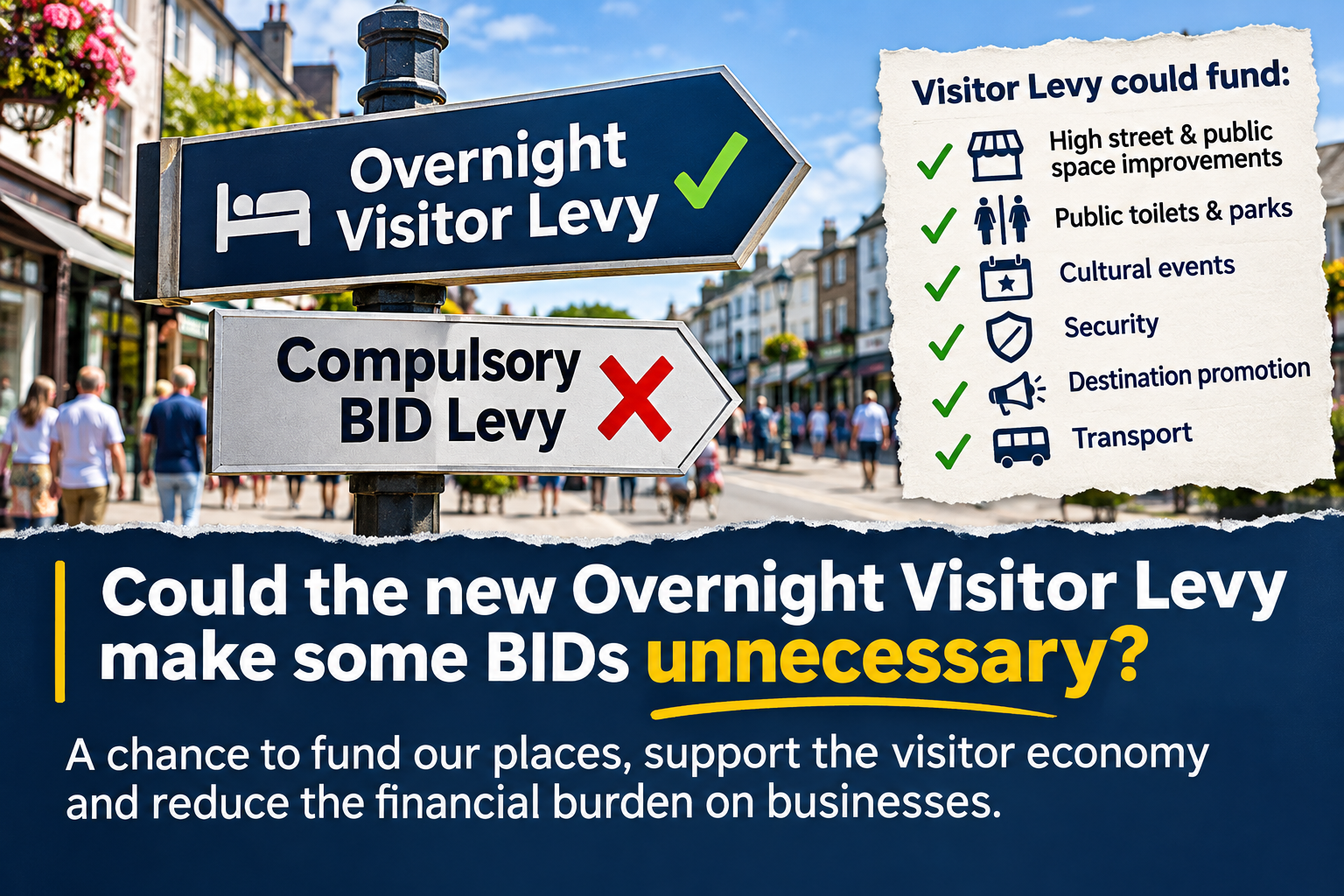
Could the new Overnight Visitor Levy make some Business Improvement Districts (BIDs) unnecessary?
The introduction of the Visitor Levy (England) Bill presents an interesting opportunity to rethink how we fund improvements to our towns, cities and visitor destinations.
The November 2026 British BIDs Annual Conference highlighted just how significant this new funding mechanism could be, with discussion by some about the risk it could pose to BIDs.
The amount raised by a Visitor Levy in an area is likely to dwarf what BIDs raise through their compulsory levy on businesses, so is it an opportunity to relieve businesses of their BID costs?
The presentation from Essential Edinburgh | Certified B Corp™ suggested that Edinburghs visitor levy looks to generate over £50 million annually, compared with just £1.7 million in existing BID levy income. That's almost 30 times as much revenue!
The Government itself says visitor levy revenues could fund improvements to high streets and public spaces, public toilets and parks, cultural events, security, destination promotion and transport.
Sound familiar? These are precisely the types of activities many BIDs already charge businesses to deliver.
Indeed, reflecting on the British BIDs conference, Sophie Alexander from British BIDs acknowledged:
"The potential scale of income generated through visitor levies compared with existing BID levy income, and just how much the investment priorities could overlap is stark!"
And asked:
"So are we at risk of creating parallel funding and delivery structures when we already have established partnerships, local intelligence and delivery expertise?"
So here's a question that deserves serious consideration:
Rather than looking at how BIDs can secure a role in managing or spending this new revenue, shouldn't we be exploring whether visitor levies could replace some BID levies altogether?
After all, one of the biggest opportunities here is to reduce the financial burden on businesses, not simply create another layer of taxation and administration.
Where visitor levy revenues can adequately fund existing BID activities, there is surely a strong argument for removing the compulsory BID levy.
And if existing BID companies have the expertise to deliver services for Councils, they could still do so through appropriate contractual arrangements, without necessarily requiring a separate compulsory tax on businesses.
The arrival of visitor levies should be an opportunity to question the continued need for some BIDs, rather than automatically finding ways to preserve them, which seemed to be a recurring theme at the British BIDs conference.
Some BIDs may understandably be concerned about their future if a visitor levy is introduced in their area. But surely their first consideration should be the interests of the businesses they represent, including whether alternative funding could remove the need for those businesses to continue paying a compulsory BID levy.
Yet, judging by some of the conference commentary, the emphasis appears to be on securing a role for BID organisations in managing and influencing how this new revenue is spent, rather than exploring whether it could make their existing levies unnecessary.
Shouldn't the BID industry be asking how visitor levies could save businesses money, rather than how they might help preserve the BID industry itself?
Surely the priority should be better places, better value for money and fewer compulsory financial demands on businesses, not protecting an existing funding structure when a potentially better funded alternative is emerging.
#OvernightVisitorLevy #VisitorLevy #OVL #TouristTax #BusinessImprovementDistrict #BID #ABID #BritishBIDs #HighStreets #VisitorEconomy #BusinessRates #BIDSCONF26 #BritishBIDs #PlaceManagement